


Energy Recovery Ventilator vs Fresh Air System: Which Ventilation System Is Right for Your Home?
Choosing the right ventilation system can improve indoor air quality, reduce stale air, and support a healthier home environment. But what is the difference between an ERV and a fresh air system?
An ERV (Energy Recovery Ventilator) brings fresh outdoor air into the home while exhausting stale indoor air and recovering heat and moisture between the two air streams. A fresh air system primarily focuses on supplying fresh filtered air to improve ventilation. The right choice depends on your home’s size, climate, humidity, HVAC usage, and ventilation requirements.
Looking for Fresh Air Ventilation Systems in India? INTELLIFAN Provides best Fresh Air System Manufacturer in India
What Is an ERV (Energy Recovery Ventilator)?
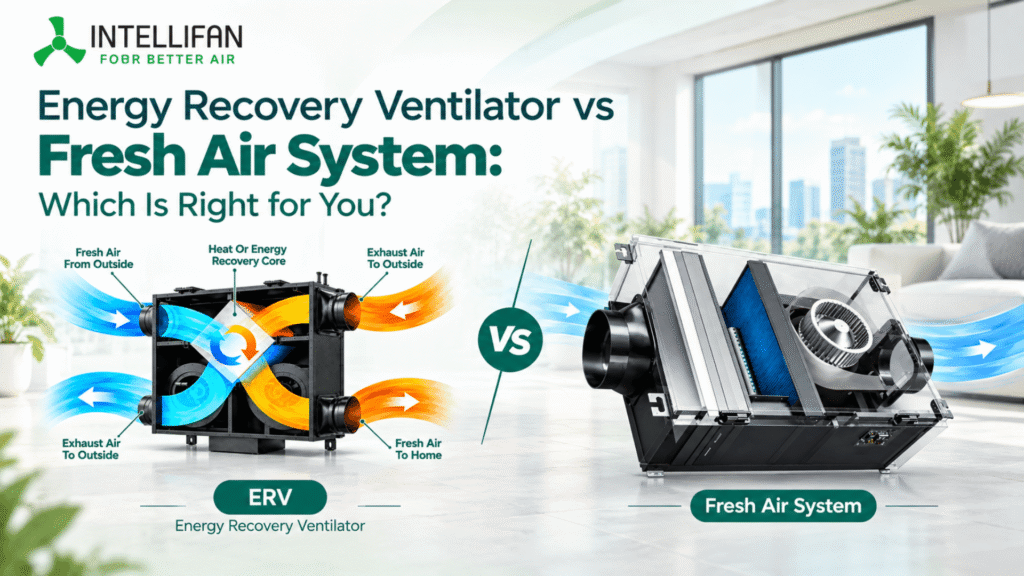
An Energy Recovery Ventilator (ERV) is a mechanical ventilation system that exchanges stale indoor air with fresh outdoor air while recovering energy from the outgoing air.
An ERV typically has separate supply and exhaust air paths. As these air streams pass through an energy recovery core, heat and moisture can transfer between them without directly mixing the two air streams.
What Does ERV Stand For?
ERV stands for Energy Recovery Ventilator.
The word “energy recovery” refers to the system’s ability to recover part of the heating, cooling, and moisture energy contained in the outgoing air.
How Does an ERV Work?
An ERV generally works in five steps:
- Outdoor air enters the ERV through an intake.
- Stale indoor air is exhausted from the building.
- Both air streams pass through the energy recovery core.
- Heat and, depending on the core, moisture are transferred between the air streams.
- Fresh, pre-conditioned outdoor air is supplied to the home.
This allows the home to receive outdoor air while reducing the impact of ventilation on indoor heating or cooling.
What Is a Fresh Air System?
A fresh air system is a ventilation system designed to bring fresh air into an indoor space.
A typical fresh air system may include an outdoor air intake, filters, fan, ductwork, and supply grilles or diffusers.
How Does a Fresh Air System Work?
The basic process is:
Outdoor air → Intake → Filtration → Fan → Indoor space
The system takes air from outside, filters it according to its design, and supplies it indoors.
Some fresh air systems are designed only to supply outdoor air, while other ventilation configurations also include mechanical exhaust. Therefore, the exact airflow arrangement depends on the system design.
Is a Fresh Air System the Same as an ERV?
Not exactly.
Fresh air system is a broad term for systems that introduce outdoor air into a building. An ERV is a specific ventilation technology that provides outdoor-air exchange while recovering energy, including heat and moisture transfer.
An ERV can therefore be used as a fresh-air ventilation solution with energy recovery.
ERV vs Fresh Air System: What’s the Difference?
The main difference is energy recovery.
A basic fresh air system focuses primarily on bringing outdoor air indoors. An ERV performs outdoor-air ventilation while also transferring energy between incoming and outgoing air streams.
| Feature | ERV System | Fresh Air System |
| Outdoor air supply | Yes | Yes |
| Stale-air exhaust | Typically yes | Through leakages |
| Heat recovery | Yes | Usually no |
| Moisture recovery | Yes | Usually no |
| Energy recovery | Yes | Usually no |
| Filtration | Yes | Yes |
| Balanced ventilation | Designed for balanced operation | Works on positive pressure |
| Humidity transfer | Yes, through recovery core | No |
| Load on HVAC | Does not affect the AC load much | Can increase the load on your AC |
| Main purpose | Ventilation + energy recovery | Fresh-air ventilation |
The exact performance depends on the equipment, installation, airflow, controls, climate, and building design.
How Do ERV and Fresh Air Systems Work Differently?
Outdoor Air Intake
Both systems can bring outdoor air into a building through a dedicated intake.
The difference is what happens to that outdoor air before it reaches the occupied space.
Stale Indoor Air Exhaust
An ERV normally uses a separate exhaust air path to remove stale indoor air. A fresh air system is usually designed to maintain positive air pressure which helps to exhaust stale air through leakages and stops uncontrolled infiltration.
Heat Recovery
An ERV transfers heat between outgoing and incoming air streams through its recovery core.
For example, during a hot period, cooler indoor exhaust air can help reduce the temperature of incoming outdoor air.
During a cold period, warmer indoor exhaust air can transfer heat to incoming outdoor air.
Moisture Recovery
An ERV can also transfer moisture between air streams.
This can help moderate the effect of outdoor humidity on indoor conditions, although an ERV is not a replacement for a dedicated dehumidifier or humidifier.
Balanced Ventilation
An ERV is designed to provide both supply and exhaust airflow. When properly designed and balanced, this creates controlled mechanical ventilation rather than relying only on uncontrolled air leakage.
ERV vs Fresh Air System for Indoor Air Quality
Both systems can support indoor air quality by introducing clean fresh air.
Fresh-air ventilation can help dilute indoor contaminants and reduce the buildup of stale air and carbon dioxide.
An ERV provides the same basic ventilation function while also recovering energy between the outgoing and incoming air streams.
Does an ERV Improve Indoor Air Quality?
Yes. An ERV can support indoor air quality by continuously supplying outdoor air and exhausting stale indoor air.
However, overall indoor air quality also depends on use of good quality filtration, outdoor air quality, indoor pollution sources, airflow rates, and proper system maintenance.
Does an ERV Filter Outdoor Air?
Yes, ERV systems include filters, but filtration performance depends on the specific model and filters used.
If outdoor pollution or fine particles are a major concern, check the ERV’s filter type and filtration specifications.
Can an ERV Replace an Air Purifier?
Not necessarily.
An ERV provides ventilation, while an air purifier primarily filters indoor air.
For some homes, both technologies may serve different purposes.
Energy Recovery Ventilator vs Fresh Air System: Which Is Better for Humidity?
An ERV can be useful where moisture management is important because its recovery core can transfer moisture between the incoming and outgoing air streams.
A Fresh air system without energy recovery does not normally provide the same moisture-recovery function.
Does an ERV Control Humidity?
An ERV can help moderate indoor humidity, but it should not be considered a dedicated humidity-control appliance.
Actual indoor humidity depends on outdoor conditions, air-conditioning or heating, occupancy, building construction, ventilation rate, and the ERV’s performance.
Energy Recovery Ventilator vs Fresh Air System: Which Uses Less Energy?
An ERV consumes higher power compared to fresh air system, but can reduce the energy impact of ventilation because it recovers part of the energy contained in the exhaust air.
While a fresh air system consumes much less power, it brings fresh air into the building, but since the incoming air is not pre-conditioned, it may increase the load on indoor cooling or heating systems.
This means an ERV can help reduce ventilation-related heating or cooling loads, although actual energy savings depend on climate, airflow, operating hours, equipment efficiency, and building conditions.
Energy Recovery Ventilator vs Fresh Air System for Indian Homes
Indian homes experience different climate conditions, from hot and dry regions to warm and humid coastal areas. Therefore, ventilation requirements can vary significantly.
An ERV may be useful for homes where:
- Air conditioning is used regularly
- Controlled outdoor-air ventilation is required
- Humidity management is important
- Energy recovery is desired
- The home is relatively airtight
- Balanced ventilation is preferred
A fresh air system may be suitable when the primary requirement is simply to introduce filtered fresh air into rooms.
The right solution should be selected based on actual airflow, occupancy, climate, filtration, ductwork, and building requirements.
When Should You Choose an ERV?
An ERV may be worth considering when you want:
- Fresh outdoor-air ventilation
- Continuous stale-air exhaust
- Heat recovery
- Moisture recovery
- Balanced mechanical ventilation
- Reduced ventilation-related HVAC load
- Better control over outdoor-air exchange
ERVs can be particularly relevant for modern, relatively airtight homes where natural air leakage may not provide sufficient controlled ventilation.
When Is a Fresh Air System a Practical Choice?
A fresh air system can be considered when your main requirement is introducing fresh filtered air into an indoor space.
It may be appropriate for:
- Homes
- Apartments
- Offices
- Commercial spaces
- Schools
- Gym and health centers
- Spaces requiring controlled fresh-air supply
The system should still be correctly sized and designed for the required airflow and filtration.
Energy Recovery Ventilator vs Fresh Air System: Installation Differences
Both systems require Fresh-air intake and indoor-air distribution.
An ERV typically requires:
- Supply ductwork
- Exhaust ductwork
- More space
- Design and planning at construction stage
A fresh air system is usually simpler, plug and play, and can be installed without much civil work.
Proper airflow calculation and intake placement are important for both systems.
Energy Recovery Ventilator vs Fresh Air System: Maintenance
Both systems require regular maintenance.
ERV Maintenance
Typical maintenance includes:
- Cleaning or replacing filters
- Cleaning the recovery core
- Inspecting controls
Fresh Air System Maintenance
Typical maintenance includes:
- Filter replacement or cleaning
- Inspecting controls
Maintenance frequency depends on the equipment, operating hours, filter type, outdoor air quality, and manufacturer’s recommendations.
How to Choose Between an ERV and a Fresh Air System
Before choosing a ventilation system, consider:
1. Home Size
Larger homes generally require greater ventilation airflow.
2. Occupancy
The number of people using the space affects fresh-air requirements.
3. Required Airflow
Check the required CFM or airflow rate rather than selecting equipment based only on room size.
4. Climate
Outdoor temperature and humidity can influence whether energy and moisture recovery are valuable.
5. Filtration
Consider the required level of outdoor-air filtration based on local air quality and indoor requirements.
6. HVAC Usage
Homes that frequently use air conditioning or heating may benefit from recovering energy from exhaust air.
7. Installation
Consider available space, duct routes, electrical requirements, intake location, and exhaust location.
Looking for Energy Recovery Ventilator? INTELLIFAN Provides best Energy Recovery Ventilator Supplier in India
Choose the Right Fresh-Air Ventilation Solution with INTELLIFAN
INTELLIFAN provides ventilation and fresh-air solutions designed to support better indoor air quality in homes, offices, and other indoor spaces. From fresh-air ventilation systems to energy recovery solutions, INTELLIFAN focuses on practical airflow, filtration, and ventilation requirements for modern buildings.
When choosing between a standard fresh air system and an ERV, consider factors such as required airflow, room size, occupancy, climate, humidity, filtration, and HVAC usage. INTELLIFAN can help you understand these requirements and select a ventilation solution suited to your space.
Explore INTELLIFAN ventilation solutions for fresh, filtered, and controlled indoor airflow.
Energy Recovery Ventilator vs Fresh Air System: Quick Decision Guide
Consider an ERV if: You want fresh-air ventilation combined with heat and moisture recovery and balanced supply and exhaust airflow.
Consider a fresh air system if: Your primary requirement is introducing fresh air into the home and energy recovery is not a major requirement.
Talk to an Intellifan ventilation expert in your city if you are not sure which system is suitable for your space.
Final Takeaway: Energy Recovery Ventilator vs Fresh Air System
Both ERVs and fresh air systems can improve ventilation by introducing outdoor air into a building. The key difference is that an ERV combines ventilation with energy recovery.
A fresh air system may be suitable when the primary goal is supplying outdoor air. An ERV may be considered when you also want heat and moisture recovery, balanced ventilation, and reduced ventilation-related HVAC loads.
Before selecting a system, evaluate airflow, occupancy, climate, humidity, filtration, HVAC usage, ductwork, and installation requirements. The right ventilation system should be matched to the actual needs of the home.