


What Is Positive Pressure Ventilation? How It Helps Improve Indoor Air Quality
Positive pressure ventilation is a mechanical ventilation method that supplies filtered outdoor air into a building at a controlled rate, creating slightly higher indoor air pressure. This helps introduce fresh air, dilute stale indoor air, and can reduce the entry of unwanted air through uncontrolled gaps in the building envelope. Its effectiveness depends on system design, filtration, airflow, building characteristics, and climate.
Looking for Fresh Air Ventilation Systems in India? INTELLIFAN Provides best Fresh Air System Manufacturer in India
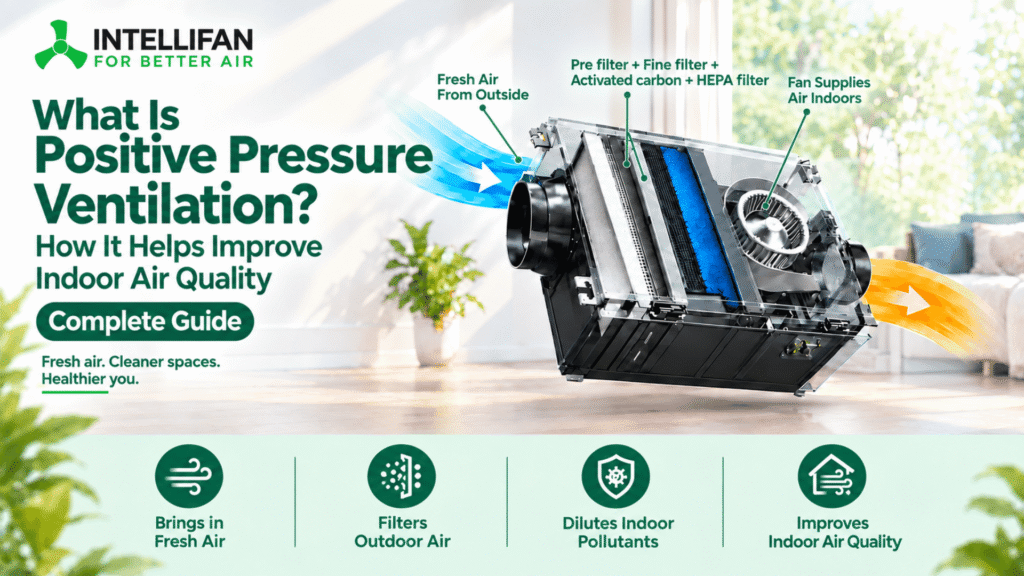
What Is Positive Pressure Ventilation?
Positive pressure ventilation is a ventilation strategy that supplies outdoor air into a building so that indoor air pressure becomes slightly higher than the surrounding pressure.
The incoming air is typically filtered before being distributed into occupied spaces. As more outdoor air enters, indoor air is displaced and leaves through designated exhaust points, openings, or other leakage paths, depending on the building and ventilation design.
A positive pressure ventilation system may be used in homes, apartments, offices, and other buildings where controlled outdoor-air supply is needed.
The main objectives are to:
- Introduce fresh outdoor air
- Improve air exchange
- Dilute indoor pollutants
- Reduce stale air
- Support indoor air quality
- Control the direction of uncontrolled air movement
Positive pressure ventilation is sometimes referred to as PPV. In residential applications, the related term Positive Input Ventilation (PIV) is also commonly used.
How Does Positive Pressure Ventilation Work?
A positive pressure ventilation system generally works through a controlled supply of outdoor air.
1. Outdoor Air Enters the System
The system draws outdoor air through an intake point. Depending on the design, the intake may be located on an exterior wall, roof, or another suitable location.
The location is important because the system should draw air from an appropriate source rather than from an area exposed to avoidable contaminants.
2. Air Passes Through a Filter
Before the air enters occupied areas, it can pass through a filtration stage.
The type and efficiency of filtration depend on the ventilation system. Filters may be selected to address different airborne particles, including dust and particulate matter.
Filter selection is especially important in locations where outdoor air contains elevated levels of PM2.5 or other pollutants.
3. The Fan Supplies Air Indoors
A ventilation fan moves the filtered outdoor air into the building.
The airflow may be distributed through ducts, grilles, diffusers, or another air-delivery arrangement depending on the system design.
4. Indoor Pressure Increases Slightly
Continuous supply airflow creates a small pressure difference between the indoor and outdoor environment.
This is the defining feature of positive pressure ventilation.
The goal is not to create a large pressure difference. Instead, the system is designed to provide controlled airflow and influence the direction in which air moves through the building.
5. Stale Air Leaves the Building
As fresh outdoor air is supplied, indoor air is displaced and exits through available exhaust routes, ventilation openings, or leakage paths like door gaps.
The actual airflow pattern depends on the building envelope, room layout, exhaust systems, door and window operation, and system design.
Research on residential PIV has shown that supply-only ventilation can increase air-change rates when appropriately combined with air vents and controls.
How Does Positive Pressure Ventilation Improve Indoor Air Quality?
Positive pressure ventilation can improve indoor air quality by supplying controlled outdoor air, diluting indoor pollutants, and helping replace stale air with filtered fresh air.
Indoor air can contain pollutants generated by cooking, cleaning, occupants, building materials, combustion, dust, and other sources. Without sufficient ventilation, these pollutants can accumulate.
Does Positive Pressure Ventilation Reduce PM2.5?
Yes, positive pressure ventilation can reduce indoor PM2.5 concentrations when the system provides suitable airflow and filtration, although the reduction depends on the building, outdoor conditions, filter performance, and indoor pollutant sources.
Can Positive Pressure Ventilation Help With Mould and Condensation?
Positive pressure ventilation can help reduce conditions that contribute to condensation and mould by improving ventilation and removing or diluting moisture-laden indoor air. However, it cannot replace fixing leaks, water ingress, or structural dampness.
Mould can develop when moisture remains available on surfaces for extended periods.
Ventilation may help by improving air exchange and reducing excessive indoor moisture under suitable conditions.
However, mould problems can also result from:
- Roof or plumbing leaks
- Water penetration
- Poor insulation
- Thermal bridges
- Persistent high humidity
- Inadequate heating
- Building defects
These underlying problems should be addressed separately.
Does Positive Pressure Ventilation Control Humidity?
Positive pressure ventilation can influence indoor humidity, but it is not the same as a dedicated humidifier or dehumidifier.
The effect depends on the relationship between indoor and outdoor humidity.
For example, bringing outdoor air into a building can help reduce indoor moisture when the incoming air is relatively dry. In a hot and humid climate, however, outdoor air can contain significant moisture.
This is why climate should be considered when selecting a ventilation system.
Homes with high humidity may require ventilation together with air conditioning or dedicated dehumidification.
What Are the Benefits of Positive Pressure Ventilation?
Positive pressure ventilation can provide several benefits when properly designed and installed.
Fresh Outdoor Air
PPV provides a controlled way to introduce outdoor air into occupied spaces.
Better Air Exchange
Continuous or scheduled ventilation can improve air exchange compared with relying only on occasional window opening.
Supports Indoor Air Quality
Fresh-air supply can help dilute indoor pollutants and stale air.
Filtered Air Supply
When appropriate filtration is included, incoming outdoor air can be filtered before entering occupied areas.
Can Help Reduce Indoor PM2.5
Research has found reductions in indoor particulate matter following PPV installation in residential buildings.
May Help With Condensation
Improved ventilation can help manage moisture-related conditions when excessive indoor humidity is part of the problem.
Supports Consistent Ventilation
A mechanical system can provide a more predictable ventilation strategy than relying entirely on occupants to open windows.
What Are the Limitations of Positive Pressure Ventilation?
Positive pressure ventilation is not a universal solution for every indoor-air-quality problem.
Its performance can be affected by:
- Building airtightness
- Airflow rate
- Filter efficiency
- Outdoor air quality
- Indoor pollutant sources
- Room layout
- Door and window operation
- Climate
- Humidity
- Duct design
- System maintenance
PPV also does not automatically remove all indoor pollutants.
For example, an air purifier may be better suited to continuously filtering recirculated indoor air, while an ERV provides outdoor-air ventilation with energy recovery.
The appropriate system depends on the building’s specific requirements.
Final Takeaway: What Is Positive Pressure Ventilation?
Positive pressure ventilation is a mechanical ventilation approach that supplies outdoor air into a building to create a slight positive indoor pressure.
Its main role is to provide controlled fresh-air supply, improve ventilation, dilute indoor pollutants, and support better indoor air quality. Research from residential field studies has found reductions in indoor particulate matter after PPV installation, although performance varies according to building characteristics, filtration, outdoor conditions, and occupant behaviour.
For homes and buildings in India, factors such as PM2.5, humidity, climate, occupancy, air-conditioning use, filtration, airflow, and building design should be considered before selecting a ventilation system.
Positive pressure ventilation, a conventional fresh air system, and an ERV are not identical solutions. Understanding the differences helps you select a ventilation approach that matches the building’s indoor-air-quality and airflow requirements.
Improve Indoor Air Quality with the Right Ventilation Approach
INTELLIFAN provides fresh air and ventilation solutions designed to support better indoor air quality through effective airflow, air filtration, and ventilation management. Whether you need a fresh air system, positive pressure ventilation system, or energy recovery ventilation (ERV), the right solution should be selected based on the space, required fresh-air volume, filtration needs, occupancy, and overall ventilation requirements.
With solutions for residential, commercial, healthcare, hospitality, educational, and other indoor environments, INTELLIFAN helps create healthier, fresher, and better-ventilated spaces through practical ventilation solutions.
Looking for Best Ventilation Guide on Ventilation Systems?
What Is a Fresh Air System? | What is an Energy Recovery Ventilator (ERV)? | Fresh Air System vs Air Purifier | Energy Recovery Ventilator vs Fresh Air System