


What Is a Fresh Air System? How It Works & Benefits
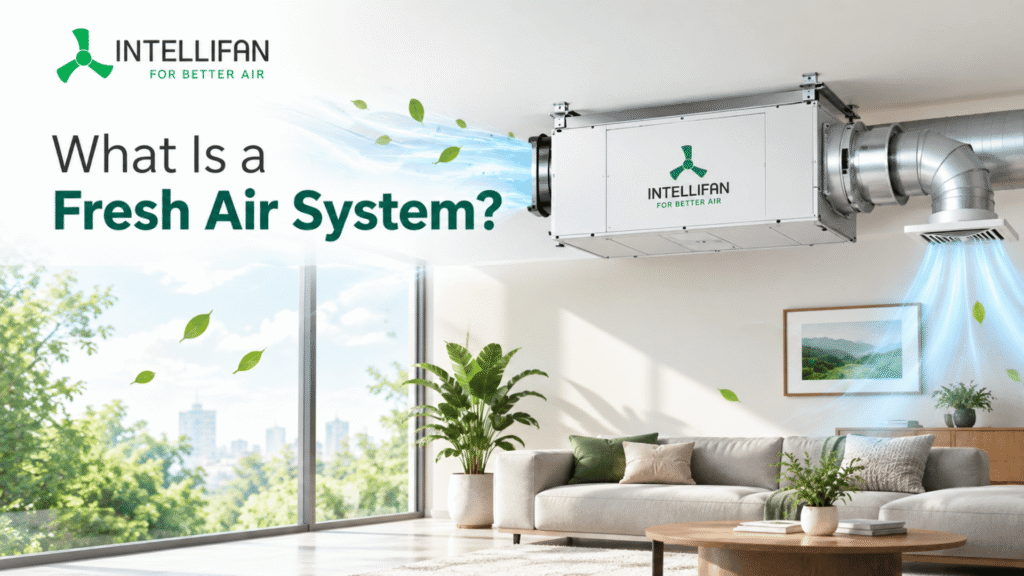
A fresh air system is a mechanical ventilation system that brings outdoor air into an indoor space through a controlled intake, ventilation fan and, depending on the system, one or more filtration stages. The filtered air can then be supplied through ducts, grilles or diffusers.
Unlike a standalone air purifier, which primarily recirculates and filters indoor air, a fresh air system is designed to introduce outdoor air into the building.
A properly selected fresh air ventilation system can support controlled ventilation in homes, offices, classrooms, healthcare spaces, hotels, basements and other enclosed environments where natural ventilation may not provide consistent airflow.
For residential applications, system selection depends on factors such as room volume, occupancy, required outdoor-air quantity, filtration requirements, duct resistance and the intended application.
How Does a Fresh Air Ventilation System Work?
A typical fresh air ventilation system follows a controlled airflow path:
Outdoor Air → Filter → Fan → Duct → Grille/Diffuser → Indoor Space
Outdoor air enters through a fresh-air intake and passes through one or more filtration stages. Depending on the model, filtration may include a pre-filter, fine filter, HEPA filter or carbon filter.
The ventilation fan moves the filtered air through the connected ductwork. Grilles or diffusers then distribute the air into the occupied space.
The important distinction is that a fresh air system does more than simply move air. It combines outdoor-air intake, filtration, mechanical airflow and controlled air distribution into a ventilation process.
Why Does a Home Need Fresh Air Ventilation?
Modern homes can become relatively enclosed because of building construction, closed windows, air conditioning and limited natural ventilation. When outdoor-air exchange is insufficient, indoor pollutants and CO₂ generated by occupants can accumulate.
A fresh air system provides a controlled method of introducing outdoor air instead of relying entirely on open windows.
This can be particularly relevant in homes with limited natural ventilation, centrally air-conditioned spaces, enclosed rooms, basements or areas where incoming outdoor air needs to pass through filtration.
However, a fresh air system should not be selected simply according to room size. Ventilation requirements also depend on occupancy, room use, desired outdoor-air quantity, filtration, duct resistance and air-distribution design.
What Is the Difference Between a Fresh Air System and an Air Purifier?
A fresh air system introduces outdoor air into an indoor space, while a conventional air purifier primarily recirculates and filters air that is already inside the room.
These technologies therefore address different requirements.
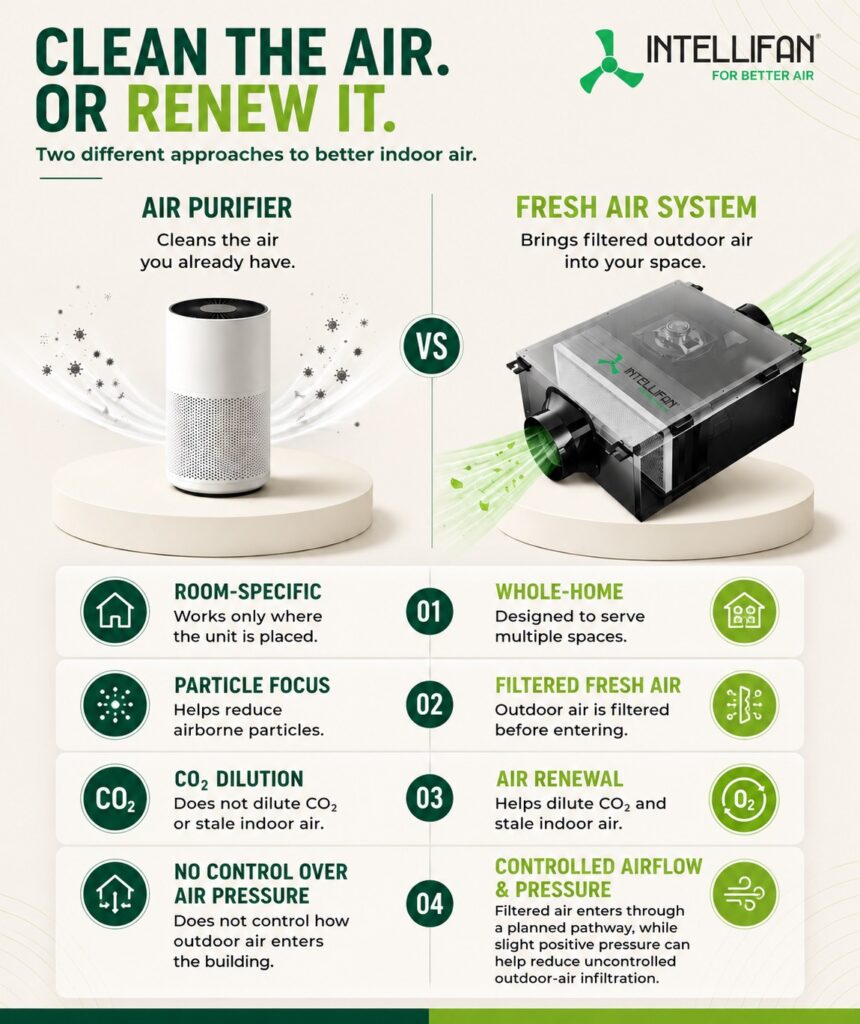
Clean the Air or Renew It?
There are two different approaches to better indoor air:
Air Purifier — Cleans the air you already have.
Fresh Air System — Brings filtered outdoor air into your space.
An air purifier can help reduce airborne particles by passing indoor air through an appropriate filter. A fresh air system focuses on ventilation by bringing outdoor air into the space and, where filtration is provided, filtering that incoming air before distribution.
| Feature | Air Purifier | Fresh Air System |
|---|---|---|
| Primary function | Filters recirculated indoor air | Introduces outdoor air |
| Air source | Indoor air | Outdoor air |
| Main focus | Particle filtration | Ventilation and air renewal |
| PM2.5 | Can reduce airborne particles with suitable filtration | Can filter incoming outdoor particles with suitable filtration |
| CO₂ | Conventional particle filtration does not remove CO₂ | Outdoor-air ventilation can dilute indoor CO₂ |
| Coverage | Typically room-specific | Can serve one or multiple spaces depending on design |
| Airflow path | Internal room-air recirculation | Outdoor intake → filter → fan → duct → supply |
| Ducting | Usually not required | Common in duct-mounted systems |
| Pressure | Not normally a ventilation-pressure system | Airflow and pressure can be considered during system design |
01 — Room-Specific vs Multiple Spaces
A portable air purifier is generally designed to clean air within the room or area where it operates. Its effectiveness depends on factors including airflow, filter performance, room size and operating time.
A ducted fresh air system can be designed to supply filtered outdoor air to multiple spaces through a planned duct network, depending on the system configuration and airflow capacity.
02 — Particle Filtration vs Filtered Fresh Air
An air purifier primarily focuses on cleaning recirculated indoor air. When equipped with an appropriate particle filter, it can help reduce airborne particulate matter such as PM2.5.
A fresh air system takes a different approach. It introduces outdoor air and can filter it before the air enters the occupied space.
INTELLIFAN fresh air systems are available with different filtration configurations, including combinations of pre-filtration, fine filtration, HEPA filtration and carbon filtration, depending on the model.
03 — What Happens to CO₂?
This is an important difference between filtration and ventilation.
A conventional air purifier does not remove indoor CO₂ simply by passing room air through a particle filter. If people continue occupying a closed room, CO₂ can continue to accumulate.
Ventilation works differently. Introducing outdoor air can help dilute indoor CO₂, particularly when the ventilation system is appropriately designed and operated.
This is why particle filtration and ventilation should not be treated as identical functions. A room can have relatively low particulate levels while still requiring adequate outdoor-air ventilation.
04 — Controlled Airflow and Pressure
An air purifier normally operates as a recirculation device within the room. It does not control how outdoor air enters the building.
A properly designed fresh air installation creates a planned airflow pathway. Outdoor air enters through an intake, passes through the specified filtration stages, moves through the ventilation equipment and is delivered through ducts, grilles or diffusers.
Depending on the system design, supply airflow can also influence the pressure relationship between indoor and outdoor spaces. Positive-pressure operation is therefore a design feature of some ventilation systems, not a universal characteristic of every fresh air system.
Fresh Air System vs Exhaust Fan: What Is the Difference?
A fresh air system supplies outdoor air, whereas an exhaust fan removes air from an indoor space.
Exhaust fans are commonly used to extract unwanted air from bathrooms, kitchens, utility areas and other spaces. A fresh air system works primarily in the supply direction by bringing outdoor air into the building.
Supply and exhaust ventilation can also work together in a properly designed ventilation arrangement.
The correct solution depends on whether the primary requirement is supplying outdoor air, removing indoor air, or managing both.
Is a Fresh Air System Better Than Opening Windows?
Opening windows provides natural ventilation, but airflow depends on factors such as wind, weather, building orientation, window position and how widely the windows are opened.
A mechanical fresh air system provides a more controlled method of introducing outdoor air and can incorporate filtration before the air enters the occupied space.
| Open Windows | Fresh Air System |
|---|---|
| Natural ventilation | Mechanical ventilation |
| Airflow varies with conditions | Airflow can be mechanically controlled |
| Outdoor air enters directly | Filtration can be incorporated |
| No dedicated ventilation fan required | Uses ventilation equipment |
| Limited airflow control | Designed around specific airflow requirements |
For some homes, natural ventilation may be sufficient. For enclosed or mechanically ventilated spaces, a dedicated fresh air system can provide greater control.
How Do You Choose the Right Fresh Air System for Your Home?
Choosing a fresh air system should involve more than comparing the CMH rating.
Consider:
- Room volume: Determine the size of the space requiring ventilation.
- Occupancy: The number of occupants affects outdoor-air requirements.
- Required outdoor air: Establish the ventilation requirement for the application.
- Filtration: Determine whether pre-filtration, fine filtration, HEPA or carbon filtration is required.
- Duct resistance: Consider duct length, bends, filters, grilles and other components.
- Static pressure: Ensure the fan has sufficient pressure capability for the connected system.
- Noise: Residential installations may require particular attention to operating noise.
- Distribution: Air should be delivered effectively through suitable grilles or diffusers.
Static pressure is the resistance a ventilation fan must overcome to move air through components such as filters, ducts, bends, grilles and diffusers. As system resistance increases, the actual airflow delivered by a fan can differ from the fan’s free-air or nominal rating.
This is why selecting a ventilation system purely by fan size or CMH can result in an unsuitable system.
What Does CMH Mean in a Fresh Air System?
CMH means Cubic Metres per Hour and describes the volume of air a system is rated to move in one hour.
For example, a 450 CMH system has a rated airflow of 450 cubic metres per hour under its applicable operating conditions.
INTELLIFAN’s known fresh air ventilation range includes systems from approximately 180 to 800 CMH, depending on the model.
The appropriate capacity should be evaluated against the application, occupancy, required ventilation, filtration and duct resistance rather than treating CMH as a standalone selection criterion.
When Should You Consider an ERV Instead?
An Energy Recovery Ventilator (ERV) exchanges indoor and outdoor air while recovering energy between the two airstreams.
A standard fresh air system is primarily focused on introducing outdoor air, while an ERV is designed for balanced ventilation with energy recovery.
An ERV can therefore be considered when a project requires controlled supply and exhaust ventilation together with energy recovery.
INTELLIFAN offers ERV systems for residential, commercial, institutional and other applications.
Source: What is an Energy Recovery Ventilator (ERV)?
How Does INTELLIFAN Approach Fresh Air Ventilation?
INTELLIFAN is a brand of Greenland Solutions, an Indian manufacturer established in 2015 and based in Sahibabad Industrial Area, Ghaziabad, Uttar Pradesh.
INTELLIFAN’s ventilation portfolio includes fresh air ventilation systems, HEPA filtration systems, hybrid fresh air systems, mixed-flow inline duct fans, centrifugal inline fans, ERVs, exhaust fans, air-quality monitors and air-distribution accessories.
This broader product ecosystem reflects a systems-oriented approach:
Measure → Ventilate → Filter → Circulate → Distribute
For a fresh air application, that can mean measuring indoor conditions, selecting the required outdoor-air capacity, filtering incoming air, moving it through the duct system and distributing it effectively inside the space.
Fresh Air System or Air Purifier: Which One Do You Need?
The right choice depends on the problem you are trying to solve.
- Want to reduce airborne particles in a particular room? An appropriately sized air purifier may be suitable.
- Want to introduce outdoor air into an enclosed space? A fresh air ventilation system is designed for that purpose.
- Need both ventilation and particle filtration? A fresh air system with suitable filtration may address both requirements.
- Need controlled supply and exhaust with energy recovery? An ERV may be more appropriate.
The key distinction is simple:
An air purifier cleans the air you already have. A fresh air system renews indoor air by bringing in outdoor air, with filtration where provided.
These technologies are not necessarily substitutes. Depending on the building and indoor-air requirements, air purification and ventilation can serve complementary purposes.
Get best Fresh Air Ventilation System with INTELLIFAN
INTELLIFAN brings together fresh air ventilation, filtration, ducted airflow, energy recovery, air distribution and indoor air-quality monitoring as part of a broader approach to better air.
Its fresh air portfolio includes solutions designed for applications such as homes, offices, classrooms, healthcare facilities, hotels, basements and commercial spaces.
From selecting the appropriate airflow capacity to considering filtration and duct resistance, the objective is to approach ventilation as a complete airflow system rather than simply choosing a fan.
INTELLIFAN — For Better Air.