


What Is a Duct Fan? Types, Uses & How to Choose One
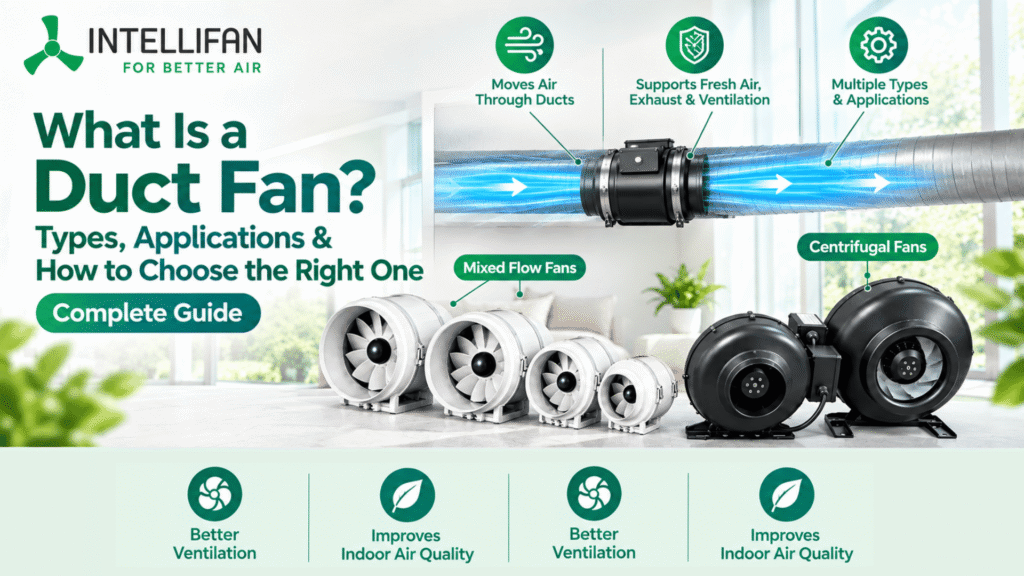
A duct fan is designed to move air through a duct system. It can be used to exhaust indoor air, supply fresh air, or transfer air between spaces.
Unlike a normal room fan, which circulates air within a room, a duct fan has to move air through a defined pathway and overcome resistance from ducts, bends, filters, grilles and other components.
In simple terms:
Air In → Fan → Duct → Air Out
The right fan depends mainly on airflow and static pressure, not just the fan’s maximum CFM or CMH rating.
How Does a Duct Fan Work?
A duct fan creates a pressure difference that moves air through the duct.
For exhaust:
Room → Duct → Fan → Outdoor Air
For fresh-air supply:
Outdoor Air → Filter → Fan → Duct → Room
The longer and more restrictive the duct system, the more pressure the fan needs to overcome.
For example, a short straight duct has much less resistance than a long duct with several bends, a filter, damper and grille.
What Is an Inline Duct Fan?
An inline duct fan is installed directly inside the ductwork rather than directly on a wall or ceiling.
This makes it useful when the fan needs to be concealed or when air needs to travel through a longer duct.
Common applications include:
- Bathroom ventilation
- Kitchen exhaust
- Basement ventilation
- Fresh-air supply
- Offices
- Commercial spaces
- General air extraction
An inline duct fan can be used for either supply or exhaust, depending on how the system is designed.
Types of Duct Fans
The three common designs are axial, mixed-flow and centrifugal.
Axial Duct Fans
Axial fans are generally suited to applications requiring high airflow with relatively low system resistance.
Mixed-Flow Duct Fans
Mixed-flow fans combine characteristics of axial and centrifugal designs. They provide a useful balance between airflow and pressure, making them suitable for many residential and commercial ducted ventilation applications.
Centrifugal Duct Fans
Centrifugal fans are commonly considered when the system has higher resistance or greater static-pressure requirements, such as long duct runs, multiple bends or filtration.
Important: Fan type alone does not determine performance. Always check the manufacturer’s performance curve.
Where Are Duct Fans Used?
Duct fans can be used in many ventilation applications.
Homes
Bathrooms, kitchens, basements, utility rooms and fresh-air systems.
Offices & Commercial Spaces
Offices, restaurants, hotels, retail spaces and other occupied areas.
Industrial Applications
Factories, workshops, warehouses and process ventilation systems.
Fresh-Air Ventilation
A duct fan can introduce outdoor air through a filtered ventilation system:
Outdoor Air → Filter → Fan → Duct → Indoor Space
This makes duct fans useful as part of a broader fresh-air ventilation system.
How to Choose the Right Duct Fan
There are four things you should establish before selecting a duct fan:
1. Required Airflow
Airflow is usually expressed in CFM or CMH (m³/h).
For general ventilation, a basic starting point is:
Airflow = Room Volume × Required Air Changes per Hour
The required airflow ultimately depends on the room, occupancy, application and ventilation requirements.
2. Static Pressure
This is critical for ducted systems.
The fan needs enough pressure to overcome resistance from:
- Duct length
- Bends and elbows
- Filters
- Dampers
- Grilles
- Diffusers
A fan rated at 500 CMH does not necessarily deliver 500 CMH once connected to a restrictive duct system.
3. Duct Size
Common duct sizes include 100, 150, 200, 250 and 300 mm.
But duct diameter alone does not determine fan performance. The required airflow and system resistance must also be considered.
4. Noise & Power
For bedrooms, homes, offices and hospitality spaces, acoustic performance matters.
Also compare the fan’s power consumption at the required airflow and pressure, rather than choosing simply by the lowest wattage.
Mixed-Flow vs Centrifugal: Which One?
As a general guide:
| Mixed-Flow | Centrifugal | |
| Airflow | Good | Application-dependent |
| Pressure | Moderate–high* | Generally higher |
| Moderate duct resistance | ✓ | ✓ |
| Long/high-resistance ducts | Depends on model | Often suitable |
| Typical use | Residential & commercial ventilation | Higher-resistance systems |
Actual capability depends on the specific model.
The best way to select between them is to compare the fan performance curve with the required airflow and static pressure.
The Most Important Rule
Don’t select a duct fan only by its advertised maximum CFM/CMH.
Instead, ask:
How much airflow will this fan actually deliver?
That is the number that matters in a real installation.
Choose the Right Duct Fan with INTELLIFAN
INTELLIFAN offers ducted air movement and ventilation solutions for residential, commercial and industrial applications.
The range includes:
- Mixed-flow inline duct fans
- Centrifugal inline duct fans
- Fresh-air ventilation systems
- Exhaust ventilation solutions
Whether you need bathroom extraction, fresh-air supply, commercial ventilation or a higher-pressure ducted system, fan selection should always be based on the actual airflow, pressure and system requirements.
INTELLIFAN — For Better Air.
Looking for Best Ventilation Guide on Ventilation Systems?
What Is a Fresh Air System? | What is an Energy Recovery Ventilator (ERV)? | Fresh Air System vs Air Purifier | Energy Recovery Ventilator vs Fresh Air System