


BLDC Fans vs Conventional Fans: How BLDC Technology Saves Energy
Ceiling fans are among the most frequently used appliances in Indian homes, offices, classrooms, shops and commercial spaces. Because they often operate for several hours every day, even a difference of a few watts can add up to significant electricity consumption over time.
This is where BLDC fans have gained attention as an energy-efficient alternative to conventional ceiling fans.
A BLDC fan uses a Brushless Direct Current motor with electronic control instead of the traditional induction motor commonly found in conventional fans. Depending on the specific models being compared, BLDC fans can consume substantially less electricity while still delivering comparable air movement. Government and consumer-testing sources commonly cite BLDC fan power consumption in the range of roughly 25–35W, while conventional fans can commonly be around 50–80W or higher depending on the model and operating condition.
But how exactly does BLDC technology save energy? And how much difference can it make to your electricity bill?
Let’s compare BLDC fans and conventional fans and understand the technology behind their energy efficiency.
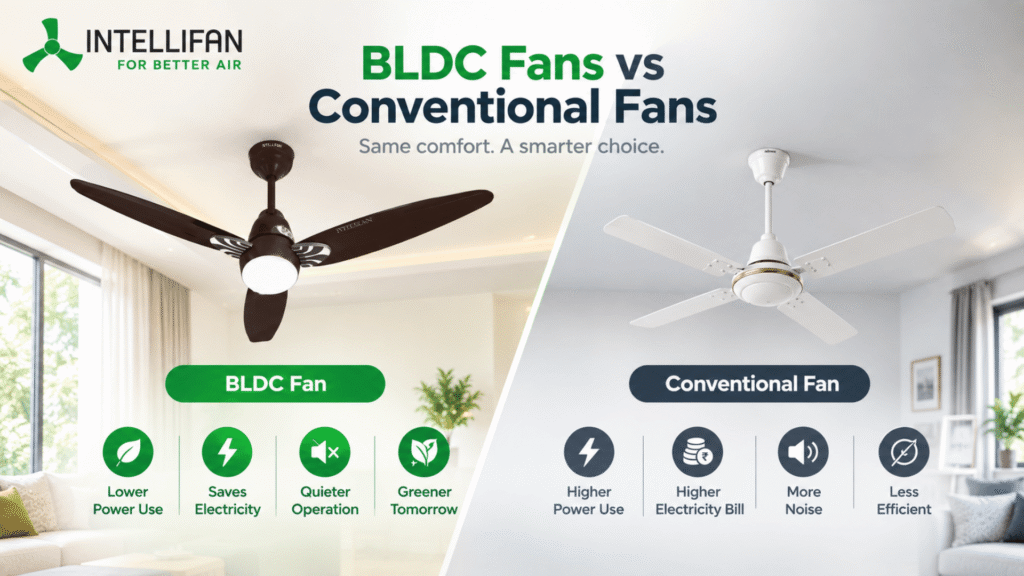
What Is a BLDC Fan?
BLDC stands for Brushless Direct Current.
A BLDC ceiling fan uses a brushless motor controlled electronically. Instead of relying on the operating principle of a conventional AC induction motor, the BLDC motor uses permanent magnets and electronic commutation to produce rotation.
The electronic controller regulates the motor’s operation and speed. This allows the fan to operate efficiently while delivering the required airflow.
The basic idea is simple:
Efficient motor operation → lower electrical input → lower power consumption → lower running cost
BLDC technology is not new. It has been used in various applications where motor efficiency and controlled operation are important. Its application in ceiling fans has made it possible to reduce the electrical power required for everyday air circulation. Bureau of Energy Efficiency describes BLDC ceiling fans as an energy-saving application of brushless DC motor technology.
Looking for BLDC Fan in India? INTELLIFAN is the best BLDC Fan Manufacturer in India
What Is a Conventional Ceiling Fan?
A conventional ceiling fan generally uses an AC induction motor.
In an induction motor, electrical energy creates the magnetic fields required to produce rotation. Some of the supplied electrical energy is lost within the motor as heat and other losses during operation.
Conventional fans remain widely used because they are familiar, relatively simple to operate and available across a broad range of prices.
However, when a fan operates for many hours every day, its power consumption becomes an important consideration.
This is why comparing the wattage, air delivery and efficiency of a conventional fan with a BLDC fan can help buyers understand the potential long-term difference.
BLDC Fans vs Normal Fans: Key Differences
The biggest difference between a BLDC fan and a conventional fan is the motor technology.
| Feature | BLDC Fan | Conventional Fan |
| Motor technology | Brushless DC motor | Generally AC induction motor |
| Motor control | Electronic | Conventional AC control |
| Power consumption | Typically lower | Typically higher |
| Energy efficiency | High, model dependent | Usually Low |
| Speed control | Electronic controller/Smart remote on many models | Regulator or electronic control depending on model |
| Electricity cost | Generally lower for comparable usage | Generally higher for comparable usage |
| Inverter load | Lower because of lower power demand | Higher for equivalent operating time |
| Initial price | Often higher | Often lower |
| Best comparison metrics | Wattage + air delivery + service value | Wattage + air delivery + service value |
The exact difference varies between models. For example, the Bureau of Energy Efficiency has documented comparisons where a conventional fan consuming around 60–80W was compared with BLDC fans consuming around 28–32W. Consumer Affairs testing material has also used a 75W conventional fan versus a 30W BLDC fan for an illustrative energy-consumption comparison.
Therefore, instead of assuming that every BLDC fan uses a particular wattage, check the specifications of the actual models being compared.
How Does BLDC Technology Save Energy?
The main reason BLDC fans consume less electricity is their motor design and electronic control.
1. Brushless Motor Technology
As the name suggests, a BLDC motor does not use mechanical brushes for commutation.
Instead, electronic circuitry controls the switching of current through the motor windings.
This eliminates the brush-related mechanical losses associated with brushed motor designs and enables precise motor control.
2. Permanent-Magnet Motor Design
BLDC motors use permanent magnets in the rotor.
This differs from the operating principle of a conventional induction motor, where the rotor’s magnetic field is induced.
The permanent-magnet design contributes to efficient torque production and helps reduce certain electrical losses.
BEE documentation describes BLDC motors as using permanent magnets and electronic commutation, with the resulting ceiling-fan application providing significantly lower power consumption in the examples studied.
3. Electronic Speed Control
A BLDC fan uses an electronic controller to regulate motor operation.
Instead of simply supplying power through a conventional control arrangement, the controller manages the motor according to the selected speed.
This helps the motor operate efficiently across different speed settings.
BEE’s published comparison shows that power consumption can vary considerably by speed level, demonstrating why actual operating conditions matter when calculating energy savings.
BLDC Fan Power Consumption vs Normal Fan
One of the easiest ways to compare fans is by looking at power consumption in watts.
Government and consumer sources provide several examples:
- Conventional/regular fan: approximately 50–80W in commonly cited examples
- BLDC fan: approximately 25–35W in commonly cited examples
The actual figure depends on the specific fan, sweep size, motor, speed, airflow and design.
For example:
Conventional fan: 75W
BLDC fan: 30W
The difference is:
75W − 30W = 45W
That means the BLDC fan requires 45W less rated electrical input in this illustrative comparison.
However, wattage should not be the only specification you consider.
A proper comparison should include:
- Power input
- Air delivery
- Sweep size
- RPM
- BEE star rating where applicable
- Speed range
- Operating conditions
Consumer Affairs guidance specifically highlights the importance of considering both air delivery and power input when evaluating ceiling fans.
How Much Electricity Does a BLDC Fan Save?
The easiest way to estimate electricity consumption is:
Electricity consumption (units) = Power in watts × Operating hours ÷ 1,000
Consider an illustrative comparison:
Conventional fan: 75W
BLDC fan: 30W
Operating time: 8 hours per day
Conventional fan
75 × 8 ÷ 1,000 = 0.60 units per day
Over 30 days:
0.60 × 30 = 18 units per month
BLDC fan
30 × 8 ÷ 1,000 = 0.24 units per day
Over 30 days:
0.24 × 30 = 7.2 units per month
Difference
18 − 7.2 = 10.8 units saved per month
This is an illustrative calculation, not a guaranteed saving for every BLDC fan.
Your actual saving depends on:
- Actual fan wattage
- Operating speed
- Number of operating hours
- Electricity tariff
- Seasonal usage
- Specific fan models being compared
Consumer Affairs’ comparative material similarly uses a 75W regular fan and 30W BLDC fan to demonstrate the potential difference in annual electricity consumption.
What Factors Affect BLDC Fan Energy Savings?
Not every household will achieve the same electricity savings.
The main factors include:
1. Fan Wattage
A lower-wattage BLDC fan can reduce electricity consumption, provided it delivers the required airflow.
2. Operating Hours
A fan running 12–16 hours a day has much greater energy-saving potential than a fan used for one or two hours.
3. Operating Speed
Power consumption changes according to fan speed.
4. Electricity Tariff
The same number of saved units can produce different monetary savings depending on the electricity rate.
5. Number of Fans
Replacing multiple high-use fans increases the total potential energy saving.
6. Air Delivery
Compare airflow as well as wattage. A lower-power fan should still meet the airflow requirement for the room.
7. Existing Fan
The difference between the old fan’s actual power consumption and the new BLDC fan’s consumption determines the potential saving.
How to Choose an Energy-Efficient BLDC Fan
When comparing BLDC ceiling fans, don’t select a model based only on the word “BLDC.”
Check the actual specifications.
Check the rated power
Look at the power input in watts.
Check air delivery
A good energy-efficient fan should provide appropriate airflow for the room.
Check the sweep size
Common ceiling fan sweep sizes include 1200mm and 1400mm, but the appropriate size depends on the room and installation requirements.
Check the BEE rating
Where applicable, check the BEE star rating and the information on the product label.
Compare Service value and wattage
A useful comparison is:
Air delivery ÷ Power consumption
This gives a practical indication of how much airflow is obtained for the electrical input.
Check the control system
Many BLDC fans use remote or electronic controls. Check compatibility with the intended installation.
Consider inverter usage
If the fan will operate on inverter backup, its power consumption becomes particularly important.
Check warranty and service
Because BLDC fans include electronic control components, consider warranty coverage and service availability before purchase.
BLDC Fans vs Conventional Fans: Which Is More Energy Efficient?
The answer depends on the specific models, but BLDC technology is designed to reduce the electrical power required for fan operation.
Government and consumer sources have documented BLDC ceiling fans using substantially less power than conventional fans in comparable examples. Published examples include approximately 28–32W BLDC fans compared with 60–80W conventional fans, while Consumer Affairs material cites 25–35W for BLDC fans compared with approximately 50–80W for conventional ceiling fans.
The actual energy saving for your home depends on the fan’s rated power, speed, airflow, operating hours and electricity tariff.
Therefore, the most useful way to compare two fans is not simply:
BLDC vs conventional
Instead, compare:
Power input + air delivery + operating hours + electricity cost
That gives you a much more realistic picture of long-term energy performance.
Final Takeaway: BLDC Fans vs Normal Fans
The main advantage of BLDC fans vs normal fans is its potential to deliver required air movement with significantly lower electrical power consumption.
The difference becomes especially relevant when fans operate for long hours every day.
BLDC technology achieves this through:
- Brushless motor construction
- Permanent-magnet motor design
- Electronic commutation
- Efficient speed control
- Lower electrical power requirements
However, the actual energy saving depends on the specific fan models and how they are used.
For a meaningful comparison, look beyond the marketing claim and compare wattage, air delivery, operating hours, speed and electricity tariff.
For homes, offices and commercial spaces where ceiling fans operate for many hours, choosing an energy-efficient BLDC fan can be a practical way to reduce ongoing electricity consumption while maintaining everyday air circulation.
Looking for energy-efficient BLDC ceiling fans?
Explore INTELLIFAN’s range of energy-efficient BLDC ceiling fans designed for modern residential and commercial applications. Compare power consumption, airflow and product specifications to identify the right fan for your application.
Explore INTELLIFAN BLDC Ceiling Fans
Looking for Best Ventilation Guide on Ventilation Systems?
What Is a Fresh Air System? | What is an Energy Recovery Ventilator (ERV)? | Fresh Air System vs Air Purifier | Energy Recovery Ventilator vs Fresh Air System