


What is an Air Circulator Fan? How It Works, Uses and Benefits
An air circulator fan moves existing indoor air through a space by creating directed airflow. Unlike a conventional fan commonly used to provide a breeze to nearby occupants, an air circulator is designed to encourage air movement beyond the area immediately in front of the fan.
Air circulator fans can be used in homes, offices, shops, workshops, warehouses and other spaces where additional air movement is required. The right model depends on the application, room layout, required airflow, installation position and operating conditions.
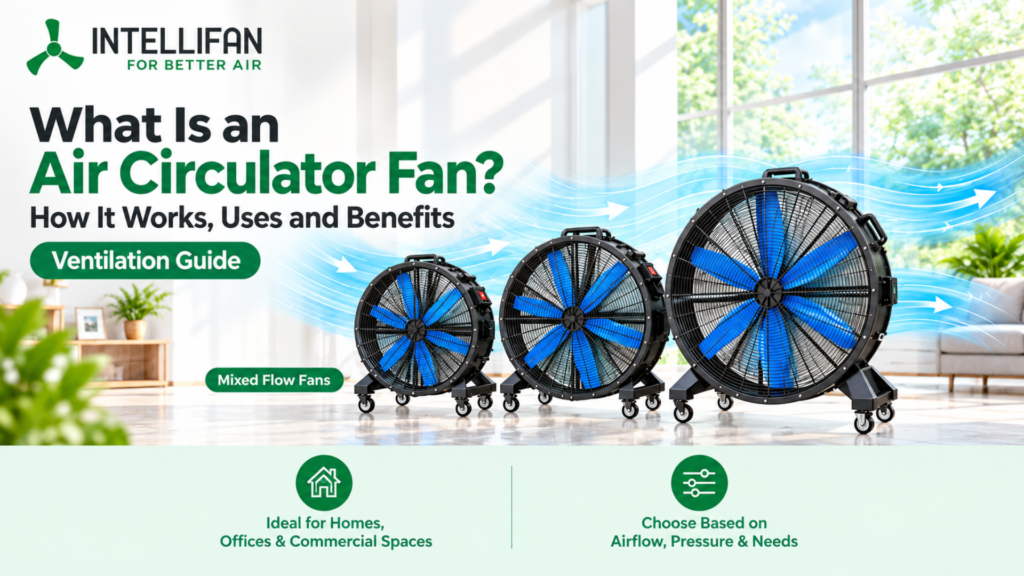
In this guide, you will learn what an air circulator fan is, how it works, its benefits and common uses, how it compares with conventional and exhaust fans, and what to consider before choosing one.
What Is an Air Circulator Fan?
An air circulator fan is designed to move air through an indoor space and encourage circulation beyond the fan’s immediate surroundings. It directs a stream of air into the room, where that moving air interacts with the surrounding air and contributes to broader air movement.
Air circulators are available in different sizes and configurations. Compact models may suit smaller spaces, while larger floor-mounted options can be considered for commercial and industrial applications when their specifications match the requirements.
The main purpose of an air circulator fan is to move existing air, not to produce refrigerated air or independently supply outdoor air. It should not be treated as a substitute for equipment designed specifically for air extraction or outdoor-air supply.
What is the Main Purpose of an Air Circulator Fan?
An air circulator fan is primarily used to:
- Encourage air movement across a room or work area.
- Help distribute conditioned air from an air-conditioning system.
- Address areas with limited air movement when positioned appropriately.
- Provide directed airflow where a fixed ceiling fan may not meet the application’s needs.
- Support air movement in suitable residential, commercial, institutional and industrial environments.
Its effectiveness depends on the fan’s design and airflow performance, the position of the unit, the room geometry and any obstructions that affect the airflow path.
How Does an Air Circulator Fan Work?
An air circulator fan draws in surrounding air and pushes it outward as a directed stream. As the moving air travels through the space, it interacts with the surrounding air and helps create circulation.
The resulting airflow depends on factors such as fan design, speed, distance, room layout, doors, windows, furniture, shelving and equipment.
How Air Circulation Happens
The process can be understood in three steps:
- Air intake: The fan draws in air from the surrounding indoor environment.
- Directed airflow: The rotating blades move air forward, producing a stream of air.
- Room circulation: The moving air interacts with the air already present in the space, encouraging air movement beyond the immediate fan location.
The extent of circulation varies with the application. A large room, high ceiling, obstructed layout or demanding industrial environment may require a different fan size, placement strategy or number of units.
What Are the Benefits of an Air Circulator Fan?
The benefits of an air circulator fan depend on how it is selected, positioned and used. Its principal advantages relate to directed airflow and the movement of air through a space.
1. Encourages Better Indoor Air Movement
An air circulator can help move air through areas where circulation is limited. This may be useful in open-plan rooms, work areas with multiple stations or spaces where furniture and equipment influence airflow.
The result depends on the fan’s specifications, placement and the conditions within the space. Simply installing a fan does not guarantee uniform airflow throughout a room.
2. Helps Distribute Air-Conditioned Air
In an air-conditioned room, an air circulator may help move conditioned air from one area towards another. Appropriate positioning can support air distribution and reduce differences in perceived comfort between areas.
However, an air circulator does not increase the cooling capacity of an air conditioner or correct every problem caused by an inadequately designed air-distribution system.
3. Provides Directed Airflow
Some applications require airflow towards a particular work area rather than airflow distributed mainly from above. A floor-mounted air circulator may be suitable where directed airflow is useful and the installation allows safe placement.
Consider the direction of airflow, the position of occupants and the location of nearby equipment before installing the unit.
4. Offers Flexible Placement
Depending on the model, an air circulator may be positioned on the floor or in another manufacturer-approved location. This can be useful where permanent ceiling installation is unsuitable or where the desired airflow direction changes.
Installation must follow the manufacturer’s instructions, including any requirements for stability, clearance and safe operation.
5. Supports Different Applications
Air circulators can be considered for residential rooms, commercial workspaces, workshops, warehouses and selected industrial environments.
The appropriate fan depends on the intended application, airflow requirements, surrounding conditions and installation constraints. Larger spaces may require a more detailed assessment rather than selecting a fan based on floor area alone.
What Are the Common Uses of an Air Circulator Fan?
Air circulator fans can support different air movement requirements across a range of environments.
Homes and Residential Rooms
Air circulators can help move air around bedrooms, living rooms, garages, basements and other suitable indoor spaces. Placement should account for furniture, room layout and the intended direction of airflow.
Offices and Workspaces
In offices, air circulators can help move air around workstations, shared spaces and open-plan layouts. They may also help distribute conditioned air where some areas experience limited air movement.
Shops and Commercial Spaces
Shops, showrooms and other commercial spaces may use air circulators to encourage air movement across occupied areas. The choice of fan should reflect the layout, intended use, installation position and operating conditions.
Workshops and Industrial Areas
Suitable air circulators can be considered for workshops, production areas and selected industrial environments where directed airflow is required.
Selection should account for the working environment, obstructions, operating conditions and any application-specific safety requirements. A standard air circulator should not be assumed suitable for hazardous environments without confirming its approved use.
Warehouses and Larger Spaces
In warehouses and large work areas, airflow can be affected by high ceilings, shelving, stored goods and machinery. Fan placement and the number of units should therefore be based on the actual airflow requirements rather than the floor area alone.
Air Circulator Fan vs Normal Fan
Both air circulator fans and conventional fans move air, but their intended airflow patterns and applications may differ. The exact comparison depends on the type and design of the fans being considered.
| Feature | Air Circulator Fan | Conventional Fan |
| Typical purpose | Encourages air movement through a space | Commonly provides a breeze for personal comfort |
| Airflow pattern | Designed to direct air through the surrounding space | Varies by fan type and design |
| Typical use | Moving air around rooms and work areas | Providing airflow to occupants |
| Placement | Depends on the intended airflow direction and model | Depends on the fan type and installation |
| Selection factors | Airflow requirements, room layout and placement | Personal comfort, installation and intended use |
Neither category is automatically better for every application. Compare the product design, specifications and intended use before choosing between them.
Air Circulator Fan vs Exhaust Fan
An air circulator fan and an exhaust fan perform different functions. An air circulator moves existing indoor air around a space, while an exhaust fan removes air from a designated area and discharges it outside.
| Feature | Air Circulator Fan | Exhaust Fan |
| Primary function | Circulates existing indoor air | Extracts indoor air |
| Main purpose | Encourages air movement within a space | Removes air from a designated area |
| Airflow direction | Directs air through the room or work area | Moves air towards an exhaust outlet |
| Typical applications | Rooms, offices, shops, workshops and suitable industrial spaces | Bathrooms, kitchens, workshops and other areas requiring extraction |
| Selection factors | Required airflow, fan specifications, room layout and placement | Extraction requirements, installation conditions, ductwork where applicable and replacement-air provision |
When Should You Choose an Air Circulator Fan?
Choose an air circulator fan when your primary requirement is to move existing air around a room or work area.
Before selecting a model, consider:
- The dimensions and layout of the space.
- The required airflow and intended direction.
- The fan’s specifications and installation position.
- Furniture, machinery and other obstacles that may affect air movement.
- The conditions in which the fan will operate.
For larger commercial and industrial spaces, assess the actual application requirements instead of choosing a fan based on size alone.
When Should You Choose an Exhaust Fan?
Choose an exhaust fan when indoor air needs to be removed from a designated area. Selection depends on the application, required extraction, installation conditions and provision for replacement air.
An exhaust fan and an air circulator are not interchangeable. One primarily circulates existing air; the other extracts air from the space.
Does an Air Circulator Fan Bring in Fresh Air?
No. A standard air circulator fan moves existing indoor air and does not independently introduce outdoor air into a building.
Air circulation and outdoor-air exchange are different functions. Although an air circulator may help distribute existing air more evenly, it does not, by itself, supply outdoor air or remove indoor air from the building.
The equipment should therefore be selected according to the actual requirement: moving air within a space, extracting air or introducing outdoor air.
How to Choose the Right Air Circulator Fan
Choosing an air circulator fan involves more than comparing fan sizes. Consider the following factors before making a decision.
1. Application and Space
Identify whether the fan will be used in a residential room, office, shop, workshop, warehouse or another environment. Different applications can have different airflow, installation and operating requirements.
2. Required Airflow
Review the manufacturer’s airflow specifications and consider the distance and direction over which air needs to move. Do not assume that a larger fan will automatically be suitable for every space.
3. Room Layout and Placement
Consider room dimensions, ceiling height, furniture, machinery, shelving and other obstructions. Positioning influences how effectively air moves through the occupied area.
4. Fan Size and Installation
Choose a model that matches the available space and intended use. Check installation requirements, clearances, stability and manufacturer instructions before installation.
5. Operating Conditions
For commercial and industrial environments, consider operating hours, surrounding conditions, access for cleaning and maintenance, and application-specific safety requirements.
6. Number of Units
Larger or obstructed spaces may require more than one fan. Determine the number and placement of units according to the actual airflow needs rather than relying on a general room-area estimate.
Where airflow requirements are complex, seek technical guidance before finalizing the selection.
Looking for an air circulator fan for your application?
Explore the INTELLIFAN Air Circulator Fans range to review available models and specifications. For commercial or industrial requirements, contact the INTELLIFAN team to discuss your application and request product information or a quotation.
Looking for Best Ventilation Guide on Ventilation Systems?
What Is a Fresh Air System? | What is an Energy Recovery Ventilator (ERV)? | Fresh Air System vs Air Purifier | Energy Recovery Ventilator vs Fresh Air System | What Is Positive Pressure Ventilation? | Balanced Ventilation System Explained | Why Indoor Air Quality Matters | How to Choose the Right Fresh Air System for Your Home | BLDC Fans vs Conventional Fans | What is an Air Circulator Fan?