


How to Improve Indoor Air Quality During Diwali and Winter Pollution
Short Answer:
Diwali celebrations and winter air pollution can make it difficult to maintain good indoor air quality, particularly in Delhi NCR, and other parts of northern India. Firecracker smoke, winter smog, cooking emissions, dust and household chemicals can all affect the air inside homes and workplaces.
Keeping windows closed during periods of heavy outdoor pollution can reduce the entry of smoke and polluted air to some extent. However, it does not eliminate pollutants generated indoors or address the need for adequate ventilation.
The most effective approach combines pollution source control, suitable air filtration and ventilation based on outdoor air quality. This guide explains 10 practical ways to improve indoor air quality during Diwali and winter, when an air purifier may help, and how a properly selected fresh-air ventilation system can support controlled outdoor-air supply.
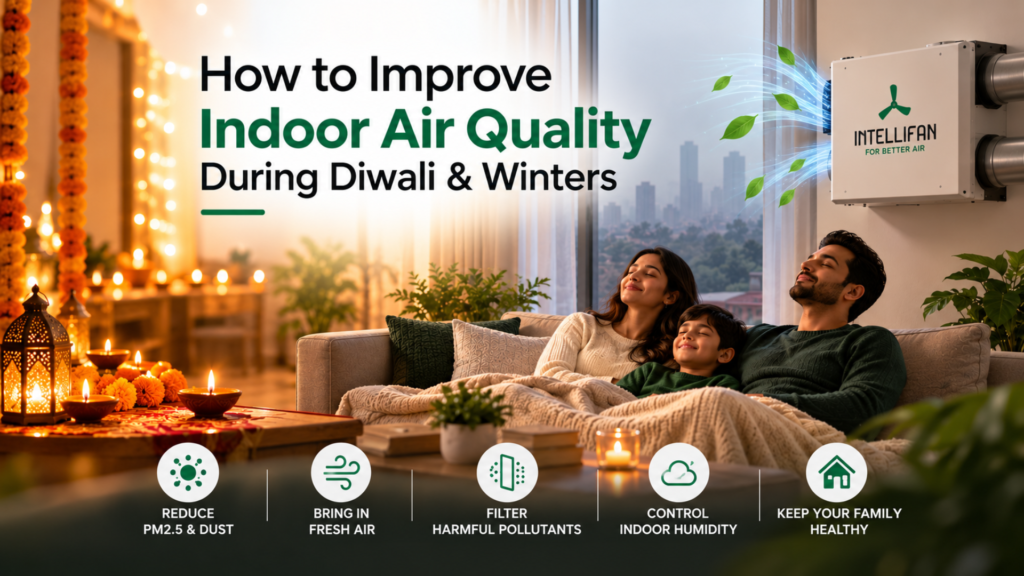
How Diwali and Winter Pollution Affect Indoor Air Quality
Indoor air quality depends on the pollutants entering a building, the activities taking place inside and how effectively the space is ventilated and maintained.
During Diwali and winter, common pollution sources include:
- Firecracker smoke: Combustion produces fine particles and other pollutants that can enter homes and workplaces.
- Winter smog: Outdoor particulate pollution can enter through open windows, doors, ventilation intakes and building gaps.
- Cooking emissions: Frying, grilling and other cooking activities can release particles and gases into the kitchen.
- Dust: Outdoor dust, construction activity, textiles and everyday household activities can contribute to airborne particles.
- Household chemicals: Certain cleaning products, paints, aerosols and fragrances release volatile organic compounds (VOCs).
- Poor ventilation: Inadequate air exchange can allow some indoor-generated pollutants to accumulate.
The right response depends on the pollutant. Particle filtration can help reduce airborne particles, exhaust ventilation can remove emissions at their source, and appropriately designed fresh-air ventilation can provide controlled outdoor-air supply.
10 Ways to Improve Indoor Air Quality During Diwali and Winter Pollution
1. Check the Outdoor Air Quality Index (AQI)
Check the local Air Quality Index before opening windows or increasing outdoor-air ventilation. India’s Central Pollution Control Board (CPCB) provides AQI information that can help you understand local air pollution conditions.
When outdoor pollution is high, avoid unnecessary exposure to polluted air. When conditions improve, use suitable opportunities to ventilate the building.
Remember that outdoor AQI does not tell you the complete condition of your indoor air. Indoor cooking, cleaning, smoke and other activities can introduce additional pollutants.
2. Reduce Indoor Pollution at Its Source
Preventing pollutants from entering indoor air is an important first step.
During Diwali and winter:
- Avoid smoking indoors.
- Minimise burning incense, candles and other materials, particularly during severe pollution episodes.
- Reduce indoor use of products that release strong fumes.
- Follow product instructions when using cleaning chemicals, paints or aerosols.
- Avoid bringing smoke-contaminated or excessively dusty items into clean indoor spaces where practical.
Reducing the source can be more effective than relying entirely on an air purifier or ventilation equipment to manage the resulting pollution.
3. Limit the Entry of Polluted Outdoor Air
When firecracker smoke is nearby or outdoor pollution is severe, keep external windows and doors closed where practical. Reduce uncontrolled entry of outdoor air through avoidable gaps, while maintaining appropriate indoor ventilation.
However, keeping windows closed is not a complete indoor air-quality strategy. Cooking, cleaning products and other indoor activities can continue to release pollutants.
Use suitable air filtration and manage ventilation according to outdoor conditions, the building’s requirements and the available equipment.
4. Ventilate When Outdoor Conditions Are Suitable
Fresh outdoor air helps dilute and remove pollutants generated indoors. Opening windows can provide natural ventilation when outdoor air quality and weather conditions permit.
During prolonged pollution episodes, a properly designed mechanical ventilation system may help manage Fresh air supply through appropriate filtration and controlled airflow.
The system should be selected according to the building’s occupancy, airflow requirements, outdoor pollution conditions and filtration needs. Simply increasing outdoor-air intake without considering pollution and filtration may not be appropriate during severe smog.
5. Use Kitchen and Bathroom Exhaust Fans
Kitchen and bathroom exhaust fans help remove specific pollutants from the areas where they are generated.
- Kitchen: Use an exhaust hood or fan that discharges outdoors to help remove cooking emissions.
- Bathroom: Use an exhaust fan that discharges outdoors to remove moisture and odours.
- Maintenance: Keep fan blades, grilles and accessible components clean according to the manufacturer’s instructions.
Exhaust ventilation requires a suitable replacement-air pathway. It is designed for local pollutant removal and does not, by itself, provide comprehensive filtration of incoming outdoor air.
6. Clean Dust Without Spreading It
Dry sweeping and aggressive dusting can redistribute settled particles into the air.
To keep indoor spaces cleaner:
- Use a damp cloth for surfaces and furniture.
- Vacuum with suitable filtration.
- Clean frequently used areas regularly.
- Wash or clean bedding and soft furnishings as appropriate.
- Keep entryways and window ledges free from excessive dust.
These measures help reduce dust accumulation, although they do not replace filtration for particles that remain airborne.
7. Maintain Air Purifiers and Ventilation Filters
Air-cleaning equipment works only as intended when its filters, airflow and operating conditions are appropriate.
Check the equipment manufacturer’s maintenance instructions and:
- Clean reusable filters only where permitted.
- Replace disposable filters according to the specified maintenance schedule.
- Ensure that filters are installed correctly.
- Keep air inlets and outlets unobstructed.
- Inspect ventilation equipment for accumulated dust or other visible contamination.
A clogged or incorrectly installed filter can affect airflow and filtration performance. Maintenance requirements vary by equipment and filter type.
8. Add Indoor Plants for a Healthier Indoor Environment
Indoor plants bring greenery into your home and may help absorb certain pollutants under controlled conditions. While they cannot replace proper air filtration, they can complement your indoor air-quality efforts.
Indoor plants to consider:
- Areca palm (Dypsis lutescens): Adds greenery and releases moisture through transpiration.
- Spider plant (Chlorophytum comosum): Studied for removing formaldehyde in controlled environments.
- Snake plant (Dracaena trifasciata): Studied for uptake of certain VOCs
- Golden pothos (money plant) (Epipremnum aureum): Studied for removing formaldehyde
- Peace lily (Spathiphyllum): Studied for uptake of benzene and formaldehyde
For healthier indoor air: Keep plant leaves clean, avoid overwatering and prevent mould growth in the soil.
Remember: Plants alone cannot effectively control Diwali smoke, fine particulate matter or winter smog. For better indoor air quality, combine indoor plants with source control, suitable air purifiers and proper ventilation.
9. Choose Household Products Carefully
Some household products release gases or vapours that particle filters alone may not remove.
Read product labels, follow usage instructions and avoid unnecessary use of strong fragrances, aerosols and solvent-based products in poorly ventilated spaces. Store chemicals safely and keep containers closed when not in use.
When a product requires ventilation during use, follow the manufacturer’s safety guidance. Do not rely on a particle-filtering air purifier as a substitute for controlling chemical emissions.
10. Consider a Fresh-Air Ventilation System
A fresh-air ventilation system supplies outdoor air to occupied spaces through a controlled intake, fan and, depending on the system, ductwork and filtration stages. Some configurations also incorporate recirculation or work alongside a separate exhaust system.
When designed with suitable filtration, a fresh-air ventilation system can help reduce the entry of airborne particles through the outdoor-air supply while supporting the building’s ventilation requirements.
Before selecting a system, consider:
- Building size and occupancy: Estimate the required outdoor-air supply based on the space and how it is used.
- Outdoor pollution conditions: Consider local dust, smoke and particulate pollution.
- Filtration requirements: Choose suitable filter stages based on the pollutants of concern and the system’s capabilities.
- Airflow and duct design: Account for duct length, bends, grilles and filter resistance.
- Maintenance access: Ensure filters can be inspected and serviced as recommended.
- Operating requirements: Consider noise, power consumption and the intended operating schedule.
For homes, offices and commercial buildings that need controlled outdoor-air supply, explore INTELLIFAN Fresh Air Ventilation Systems to review available capacities and filtration configurations.
A properly selected system can support ventilation and incoming-air filtration. Its effectiveness depends on filter performance, airflow, installation, maintenance and outdoor conditions.
Is an Air Purifier Enough During Winter Pollution?
An air purifier can help reduce airborne particles in a room, but its effectiveness depends on the filter, clean-air delivery rate, room size, placement and operating conditions.
Most portable air purifiers recirculate indoor air through their filters rather than supplying outdoor air. They can therefore complement ventilation but do not ordinarily replace the need for an adequate outdoor-air supply.
The type of pollutant also matters. A suitable particle filter can reduce airborne particles, including PM2.5, when the equipment is appropriately selected and operated. Removing certain gases and VOCs requires different air-cleaning media or technologies, and performance varies considerably.
For the best result, combine suitable particle filtration with source control and ventilation appropriate to outdoor air quality. Where controlled outdoor-air supply is also required, a fresh-air ventilation system with suitable filtration may be worth considering.
Find the Right Ventilation System to Improve Indoor Air Quality
The right solution depends on the indoor air-quality problem you need to address. Air purifiers, exhaust fans and fresh-air ventilation systems perform different functions and may complement one another.
| Solution | Main purpose | Important consideration |
| Room air purifier | Reduces airborne particles in a defined area | Does not ordinarily supply outdoor air |
| Kitchen exhaust fan | Removes cooking emissions locally | Requires a suitable replacement-air pathway |
| Bathroom exhaust fan | Removes moisture and odours | Does not provide comprehensive particle filtration |
| Fresh-air ventilation system | Supplies outdoor air, with filtration depending on configuration | Outdoor-air filtration and system design matter |
For buildings where the priority is controlled outdoor-air supply, explore INTELLIFAN Fresh Air Ventilation Systems.
The right choice depends on the building’s airflow requirements, outdoor pollution, filtration needs and HVAC design. An air purifier may be suitable for local particle reduction, while a fresh-air system addresses the additional need to introduce outdoor air into the building.
These solutions may complement one another rather than compete.
How Does a Fresh-Air Ventilation System Help Improve Indoor Air Quality?
A fresh-air ventilation system helps improve indoor air quality by supplying outdoor air to occupied spaces. Depending on the system configuration, incoming air passes through filtration stages before being distributed indoors.
During Diwali and winter pollution, a system with suitable filtration can support controlled outdoor-air supply when windows remain closed because outdoor conditions are poor. The selected filter may help reduce incoming airborne particles before the air enters the occupied space.
However, a fresh-air ventilation system is not automatically an air purifier, and not every model provides the same filtration performance. Its ability to reduce PM2.5 depends on filter efficiency, airflow, sealing, installation quality and maintenance. Gas removal depends on the type and effectiveness of the filtration media.
A fresh-air system also does not automatically remove all pollutants already present indoors. Source control, local exhaust ventilation and additional air cleaning may still be needed, depending on the building.
For effective indoor air-quality management, select a fresh-air ventilation system according to the building’s outdoor-air requirements, occupancy, outdoor pollution levels and filtration needs—not airflow capacity alone.
How to Choose the Right Indoor Air Quality Solution
Start by identifying the main problem and then select equipment that addresses it.
- If airborne particles are the main concern: Consider an appropriately sized air purifier or compatible HVAC filtration system, alongside source control.
- If cooking emissions or bathroom moisture are the main concern: Use suitable exhaust ventilation that discharges outdoors.
- If the building needs a controlled supply of outdoor air: Consider a fresh-air ventilation system with filtration appropriate to local conditions.
- If both ventilation and particle filtration are priorities: Evaluate a fresh-air system with suitable filter stages and check its performance specifications.
For larger homes, offices and commercial buildings, a ventilation assessment can help determine the appropriate airflow, filtration arrangement and system configuration.
Indoor Air Quality Tips for Different Applications
How to Improve Indoor Air Quality in Bedrooms
Keep dust under control, avoid indoor smoke sources and use suitable particle filtration where needed. Keep the air purifier’s airflow unobstructed if one is installed.
How to Improve Indoor Air Quality in Apartments
Consider how cooking emissions, outdoor-air infiltration, building ventilation and shared exhaust arrangements affect indoor air quality. Coordinate changes to common ventilation systems with building management where necessary.
How to Improve Indoor Air Quality in Offices
Maintain HVAC filters, manage indoor pollutant sources and ensure that outdoor-air supply is appropriate for occupancy and building use.
How to Improve Indoor Air Quality in Commercial Buildings
Select ventilation and filtration based on the activities taking place, the number of occupants, outdoor pollution conditions and the building’s mechanical systems.
In all these settings, equipment selection should follow the actual ventilation and filtration requirements rather than a general room-size estimate alone.
Conclusion: How to Improve Indoor Air Quality During Diwali and Winter Pollution
Improving indoor air quality during Diwali and winter pollution requires a combination of practical measures rather than dependence on one device.
Reduce pollution at its source, monitor outdoor air quality, maintain suitable filtration and manage ventilation according to the building’s needs. Air purifiers can help reduce airborne particles, exhaust fans remove specific indoor emissions, and fresh-air ventilation systems address the need for controlled outdoor-air supply.
For homes, offices and commercial buildings, the most suitable approach depends on occupancy, airflow requirements, outdoor pollution, filtration and system design.
Looking for a suitable ventilation solution for your building?
Explore INTELLIFAN Fresh Air Ventilation Systems to review available capacities and filtration options, or contact the INTELLIFAN technical team to discuss your airflow, filtration and project requirements.
Looking for Best Ventilation Guide on Ventilation Systems?
What Is a Fresh Air System? | What is an Energy Recovery Ventilator (ERV)? | Fresh Air System vs Air Purifier | Energy Recovery Ventilator vs Fresh Air System | What Is Positive Pressure Ventilation? | Balanced Ventilation System Explained | Why Indoor Air Quality Matters | How to Choose the Right Fresh Air System for Your Home | BLDC Fans vs Conventional Fans | What is an Air Circulator Fan?